Today one Neuron, tomorrow the Brain!

Today one Neuron, tomorrow the Brain!

Today one Neuron, tomorrow the Brain!

The Navy said the perceptron would be the first non-living mechanism “capable of receiv­ing, recognizing and identifying its surroundings without any human training or control.”
Mr. Rosenblatt said in prin­ciple it would be possible to build brains that could repro­duce themselves on an assembly line and which would be con­scious of their existence.

NYT 1958

John and Sam are talking about the following article:
Professor’s perceptron paved the way for AI – 60 years too soon
In this post the dialogue is realised by an interaction of virtual characters, for more information please check the page “Virtual characters

John

So you really want to compare neurons to thermostats and these “governors”?

Today 17:09

Sam

Some might disagree, but I think it is a much better comparison than all-or-nothing circuits that just represent a 1 or a 0 😊
(How Computationally Complex Is a Single Neuron?)

Today 17:10

John

That’s a good point: neurons have a graded response and integrate a lot of signals, so that is already more sophisticated than a circuit

Today 17:10

Sam

I guess that your perspective matters: for a hardware engineer, it really is about the nuts and bolts of how stuff works at the lowest levels 😅

Today 17:11

Sam

but I suppose that from the point of view of software and mathematical models you can just treat neurons as numbers or a function

Today 17:11

John

And that is why you would say that we need to look at analog computing and real time computing?

Today 17:12 

Sam

If you want to understand why it is “neuromorphic” computing, yes!
Otherwise it is just fancy statistics

Today 17:12

John

Ooh, that might be a controversial take indeed! 😏

Today 17:13 

Sam

Ha! 😄 I thought you might like to make the article a bit thought-provoking

Today 17:13

John

But then at a higher level of abstraction, when you put those artificial neurons together into a neural network …?

Today 17:15 

Sam

Well, sure, you get all the bells and whistles of machine learning and artificial intelligence, which is what your readers expect I guess

Today 17:15

John

You seem dismissive about that? 😅

Today 17:16 

Sam

I don’t mean to, no, but after hearing about this 19th century engineer, Smee, from Julia I started to think differently about it

Today 17:17

John

How so? What made you change your mind?

Today 17:18   

Sam

Well, just making a network out of stuff, doesn’t necessarily make it more “brainlike”, you know

Today 17:18

Sam

Smee just tried to link all the concepts we explicitly know we have, but we more often than not don’t know what and how our brains are doing

Today 17:18

John

So copying the structure of the brain without copying the bits and pieces it is made of doesn’t make it “neuromorphic”?

Today 17:19   

Sam

In a way, yes. We don’t have to copy everything, of course, all the biological stuff, and perhaps not even all the chemical stuff

Today 17:19

John

Just the bits that are relevant to computation, even if we don’t really see it as computation in the classical sense?

Today 17:20   

Sam

Exactly! 😊

And perhaps we end up with artificial neural networks that aren’t terribly efficient or useful

Today 17:20

John

So it depends a bit on whether you use neuromorphic computing to get quick results or to better understand the brain or computing?

Today 17:21   

Sam

Yes, and we might learn something unexpected from our brains, which are still the most efficient computers on the planet

Today 17:21

John

That was great stuff! And totally unexpected for me

Today 17:22   

Sam

You might want to check up with Cho about some of the details regarding how neurons work though …

Today 17:22

John

Excellent idea, I’ll do that right away 😊

Today 17:23   

… Continue reading our conversations that are posted every Monday …

1 Star2 Stars3 Stars4 Stars5 Stars (4 votes, average: 4.25 out of 5)
Loading...

Related post

Zap goes the Neuron

Zap goes the Neuron

If I do not greatly deceive myself, I have succeeded in realizing… the hundred years’ dream of physicists and physiologists, to wit, the identity of the nervous principle with electricity

read more

Do Neurons Count?

Do Neurons Count?

Do Neurons Count?

It is necessary to note that such “neural computers” do not execute typical machine instructions of digital computers, unless they are made to emulate the behavior of physical neural networks.
In principle, the basic processing operation performed by every processing element is an analog operation, or transformation of its input signals

Kohonen 1988

John and Sam are talking about the following article:
Neural computation

In this post the dialogue is realised by an interaction of virtual characters, for more information please check the page “Virtual characters

John

I remember Julia reporting about that, but I’m not entirely clear on how that is connected to this and neuromorphic computing

Today 17:09

Sam

OK, so think of old-fashioned scales: the bigger the weight, the more the needle moves, right? 😊

Today 17:10

John

Sure, but is that a computation?

Today 17:10

Sam

If you think about it: yes it is ! 😊
It is certainly information processing: it converts one magnitude into another. Or take a thermostat

Today 17:11

John

Ah, yes, I know that it is the favorite example of some cognitive scientists for information processing 😄

Today 17:12 

Sam

There you go: temperature acts on a sensor which then does something, like turning on the heating.

How do you think the human body does that?

Today 17:12

John

You do have a point there … I suppose that at a very basic level they work the same

Today 17:13 

Sam

That is indeed my point: you need to understand the basic level before you can appreciate what large nets of neurons can do and why that is and isn’t something special

Today 17:13

John

Fine! It’s OK, 😊

I think we can get the readers on board with this, if indeed it is going somewhere more or less familiar or expected.

Today 17:15 

Sam

Sure, we all know where this is going to go, but if you don’t see why one neuron already computes, then a neural network will just seem like voodoo

Today 17:15

John

So we have very simple systems in our body, which are similar to simple analog computers, and therefore we can speak of neuromorphic computing?

Today 17:16 

Sam

Yes, because those simple analog computers and circuits are the basic building blocks for the much more complex artificial neural networks

Today 17:17

John

Alright then! It is good to make that connection very explicit …

Today 17:17   

Sam

Certainly. The main point is that most computations aren’t like doing math on a blackboard, but so to say implicit

Today 17:17

John

So while you are moving your arm to hit the tennis ball and the sunflower is tracking the sun, they’re not “crunching numbers” as such, you mean?

Today 17:18   

Sam

Exactly, but it is still computation and it is part of a causal chain that makes stuff happen. There’s definitely rules being followed

Today 17:19

John

I think an example would be very helpful here …

Today 17:19   

Sam

Ok, think about steam engines: they had these big metal balls mounted on a valve. The faster they turned, the more they closed the valve (Centrifugal governor)

Today 17:20

Sam

in effect they continuously monitored and regulated the pressure. These were called “governors” and the example works exactly like the case of the thermostat

Today 17:20

John

Oh, wow, that’s so cool! 🤭

I never realized what those rotating ball thingies were meant to do!

Today 17:20   

Sam

You can totally compare them to neurons too: as soon as a some impulse exceeds a threshold, it elicits a response (Artificial neuron)

Today 17:20

… Continue reading our conversations that are posted every Monday …

1 Star2 Stars3 Stars4 Stars5 Stars (4 votes, average: 4.25 out of 5)
Loading...

Related post

Zap goes the Neuron

Zap goes the Neuron

If I do not greatly deceive myself, I have succeeded in realizing… the hundred years’ dream of physicists and physiologists, to wit, the identity of the nervous principle with electricity

read more
Fire All Neurons!

Fire All Neurons!

Fire All Neurons!

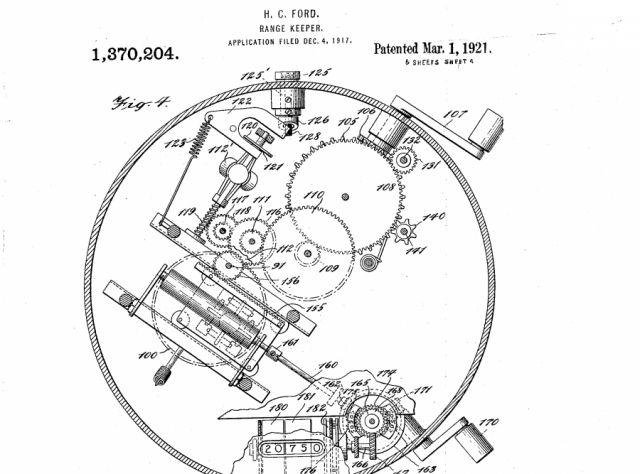
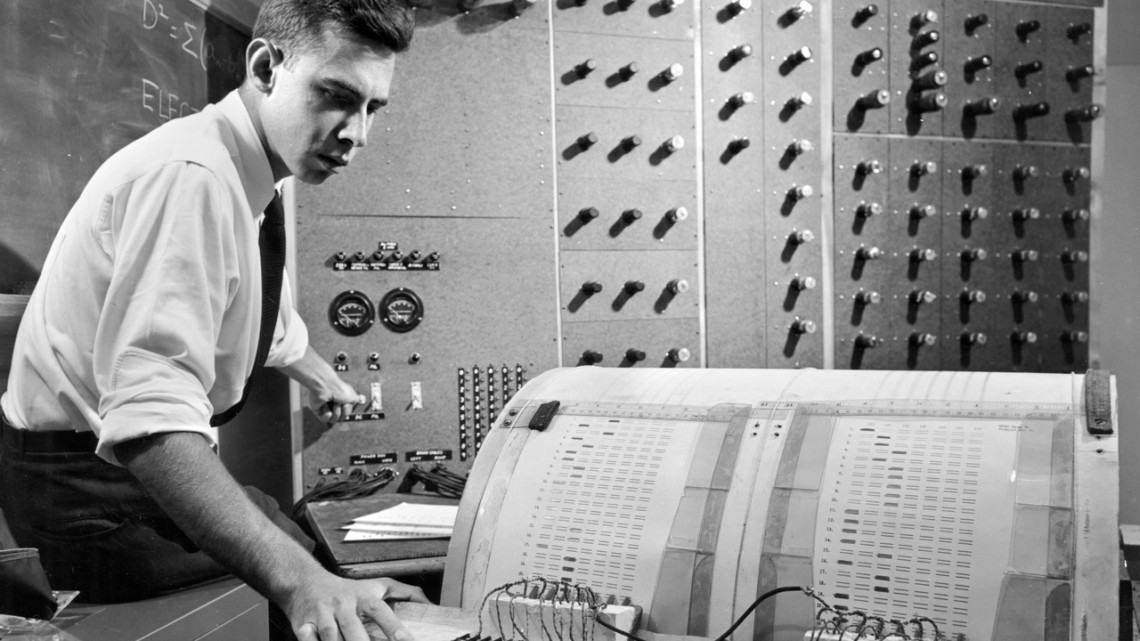
Mechanical analog computers had their origins in Naval Gunnery in World War I […] mechanical analog computers remained of considerable military importance certainly until well into the 1960s and have only been superseded by digital computing systems in the 1970s..

Bromley 1984

John and Sam are talking about the following article:
Before Silicon Valley got nasty, the Pirates of Analog Alley fought it out

In this post the dialogue is realised by an interaction of virtual characters, for more information please check the page “Virtual characters

John

Analog computing? I hadn’t really thought about that one …

Today 17:09

Sam

Well, in the beginning, it was quite superior to classical computing, because it was so much faster

Today 17:10

John

Faster? 🤨

Today 17:10

Sam

Yep, it could make quite complex calculations: a century ago analog computers for fire control on battleships solved differential equations in real time 😊                                                            

Today 17:11

John

The who with the what now?! 😄

Today 17:12 

Sam

I don’t mean to go as far back as ancient Greece, but at the beginning of the 20th century shooting the big guns on a ship accurately required a lot of calculations, in real-time (Gears of war: When mechanical analog computers ruled the waves)

Today 17:12

John

I had no idea about this … 🤔

Today 17:13 

Sam

Just like you don’t fall over when you play tennis, because your neural system integrates information about your limbs and the balance organ in your inner ear

Today 17:13

Sam

ships used gyroscopes and analogue computers to keep their guns on target despite rolling with the waves

Today 17:13

John

Wow, that certainly would involve quite a lot of computation I guess

Today 17:15 

Sam

It does! Analog computing does this in a very different way from digital computing, but that doesn’t mean it’s not computing …

Today 17:15

John

Ok, ok, fine! So these analog computers work more or less like the inner ear, therefore we might as well call it neuromorphic computing?

Today 17:16 

Sam

I’m sure some people might disagree, but basically, yes. You’d have to ask Cho about the specifics of how the brain does stuff like that though

Today 17:17

John

I must say, this isn’t really what we were looking for originally …

Today 17:17   

Sam

I guess this kind of measuring, integrating information, and reacting in real-time is a lot less sexy than finding faces in photos and animating them …

Today 17:17

John

Maybe it’s that, but I also suppose that most people wouldn’t consider this as computation at all

Today 17:18   

Sam

I’d say that someone skateboarding is solving a lot of differential equations in real-time! Or they’d crack their skulls … 😅

Today 17:19

John

Just playing devil’s advocate here 😄

Just because we can describe the system using equations, doesn’t mean that the system is computing anything …?

Today 17:19   

Sam

Ah, yeah, I can see where that is coming from .. 😊                  sunflowers don’t do astronomy just by following the sun

Today 17:20

John

That’s it, yes! So what are these navy devices and the inner ear doing exactly that makes them “computers”?

Today 17:20   

Sam

I had a whole conversation with Julia about analog vs digital, I guess this is the same kind of problem right here

Today 17:20

… Continue reading our conversations that are posted every Monday …

1 Star2 Stars3 Stars4 Stars5 Stars (4 votes, average: 4.25 out of 5)
Loading...

Related post

Zap goes the Neuron

Zap goes the Neuron

If I do not greatly deceive myself, I have succeeded in realizing… the hundred years’ dream of physicists and physiologists, to wit, the identity of the nervous principle with electricity

read more

The Brain is as the Brain does

The Brain is as the Brain does

The Brain is as the Brain does

The primary purpose of all neural systems is centralized control of various biological functions…
In the development of information technology there now seems to exist a new phase whereby the aim is to replicate many of these “Neural” functions artificially

Kohonen 1988

John and Sam are talking about the following article:
An introduction to neural computing

In this post the dialogue is realised by an interaction of virtual characters, for more information please check the page “Virtual characters

John

Hi Sam, I wanted to thank you for helping us out with our article!😊

Today 17:09

Sam

My pleasure, I enjoyed working with Julia and you 😄                        

Today 17:10

John

Can I ask you another favor though?

Today 17:10

Sam

Sure, happy to oblige 😊                                                                          

Today 17:11

John

For our next issue we’re thinking of looking at Neuromorphic Engineering

Today 17:12 

Sam

Very interesting, yes! 😊                                                                           

Today 17:12

John

There’s a lot of technical problems with the classical approach, so we thought about presenting some alternatives

Today 17:13 

Sam

Of course, but neuromorphic computing can mean a lot of different things

Today 17:13

John

Yes, that’s why we need your help! I know it is not simply “doing things like the brain

Today 17:15 

Sam

Indeed, in a very literal sense we still can’t do that                              

Today 17:15

John

But Julia’s historical approach did convince me that we are getting closer and closer, right?

Today 17:16 

Sam

I would agree, yes, but we’re still a long way off                                   

Today 17:17

John

OK, fair enough, but would you willing to collaborate on an article discussing the various approaches?

Today 17:17   

Sam

Certainly! Do you plan on going as far back as the 19th century like Julia did?

Today 17:17

John

Not this time, thought I found it quite interesting what she uncovered

Today 17:18   

Sam

So mostly 20th century stuff?                                                                   

Today 17:19

John

Yeah, we wanted to look at the parallel developments from the 1950s onwards

Today 17:19   

Sam

Side by side with the “official” history of AI? Interesting! I like it already

Today 17:20

John

Yes, that was the plan, good to heave you on board!

Today 17:20   

Sam

Can I suggest Analog Computing as the first topic?                             

Today 17:20

… Continue reading our conversations that are posted every Monday …

1 Star2 Stars3 Stars4 Stars5 Stars (4 votes, average: 4.25 out of 5)
Loading...

Related post

Total posts on the argument

Zap goes the Neuron

Zap goes the Neuron

If I do not greatly deceive myself, I have succeeded in realizing… the hundred years’ dream of physicists and physiologists, to wit, the identity of the nervous principle with electricity

read more
Found in Translation

Found in Translation

Found in Translation

Whereas perfect algorithms (or working rules) were available for the performance of the elementary arithmetical and logical operations, … no such algorithms were in existence for translation
Moreover, whereas the notion of a “correct” computation is unproblematic … the notion of a “good” translation is ridden with problems

Bar-Hillel 1962

Julia and John are talking about the following article:
Machine translation

In this post the dialogue is realised by an interaction of virtual characters, for more information please check the page “Virtual characters

Julia

I might have a good analogy!                                                                   

Today 17:08

John

Ok, let’s hear it then … 😊

Today 17:09

Julia

Perhaps we can compare it to machine translation 😊                      

Today 17:09

John

Interesting, in what way?

Today 17:10

Julia

I read somewhere that the classical approach to automating translation was to analyze every sentence according to its grammatical structure “Rule-based machine translation

Today 17:11

Julia

Find the subject, object, verb, and everything else, with their gender, number, aspect, tense, etc.  

Today 17:11

Julia

and then the translation program replaces them with their equivalent in the target language, keeping their relations the same.

Today 17:11

John

And we can compare that to the explicit programming of the laws of thought approach, right?

Today 17:12 

Julia

Indeed! But the alternative is to simply use an enormous amount of data, of translated samples, to generalize and learn through statistics

Today 17:12

John

Which is like the implicit approach? Where the rules don’t matter as long as it comes out right?

Today 17:13 

Julia

Yes, broadly. The analogy is not perfect, but I think it might help.

Today 17:14

John

I guess most people are familiar with automatic translation nowadays

Today 17:15 

Julia

That’s also why I picked this particular example                                   

Today 17:15

John

But which approach do the popular free on-line tools use?

Today 17:16 

Julia

To the best of my knowledge, they all use the statistical approach

Today 17:16

John

Very good, then we have an example that everyone can check out

Today 17:17   

Julia

This has been very interesting and instructive, thanks again for the opportunity of collaborating on this!

Today 17:18

John

Oh, well thanks to you for doing your share and more!

Today 17:18   

Julia

I look forward to doing this again sometime                                         

Today 17:19

John

Absolutely, I’ll keep you posted!

Today 17:19   

… Continue reading our conversations that are posted every Monday …

1 Star2 Stars3 Stars4 Stars5 Stars (4 votes, average: 4.25 out of 5)
Loading...

Related post

Zap goes the Neuron

Zap goes the Neuron

If I do not greatly deceive myself, I have succeeded in realizing… the hundred years’ dream of physicists and physiologists, to wit, the identity of the nervous principle with electricity

read more