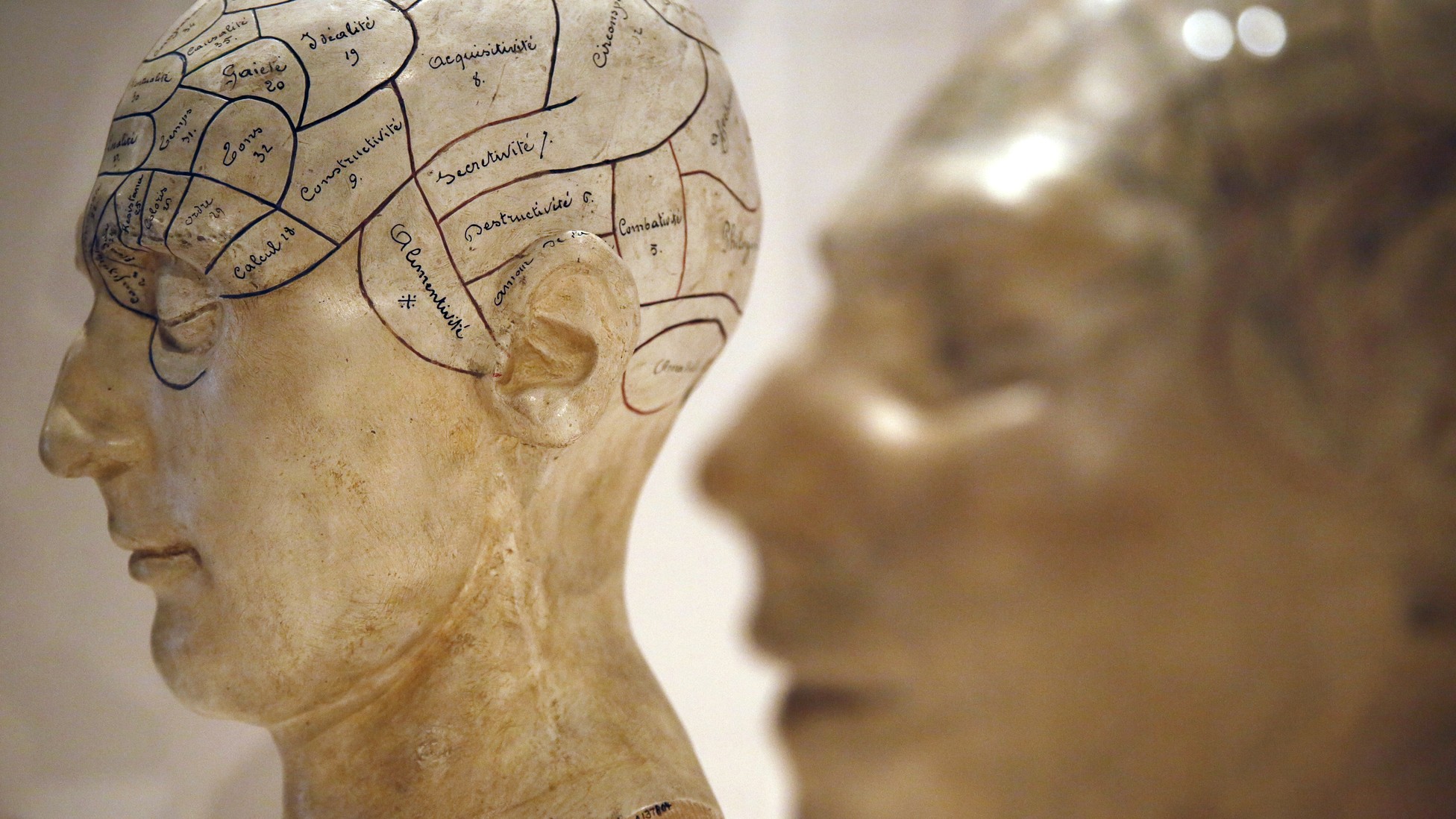
The Computer and The Brain… they like to Sing a Song

The Computer and The Brain… they like to Sing a Song

The Computer and The Brain… they like to Sing a Song

Do not touch the machine

Anton Des Roubles: I am dead – my body is dead – but I still live.
I am this machine.
These racks of apparatus are my brain, which is thinking even as yours is..

John Campbell “The Infinite Brain” 1930

Cho and John are talking about the following article:
Brain Computer Interfaces: The reciprocal role of science fiction and reality
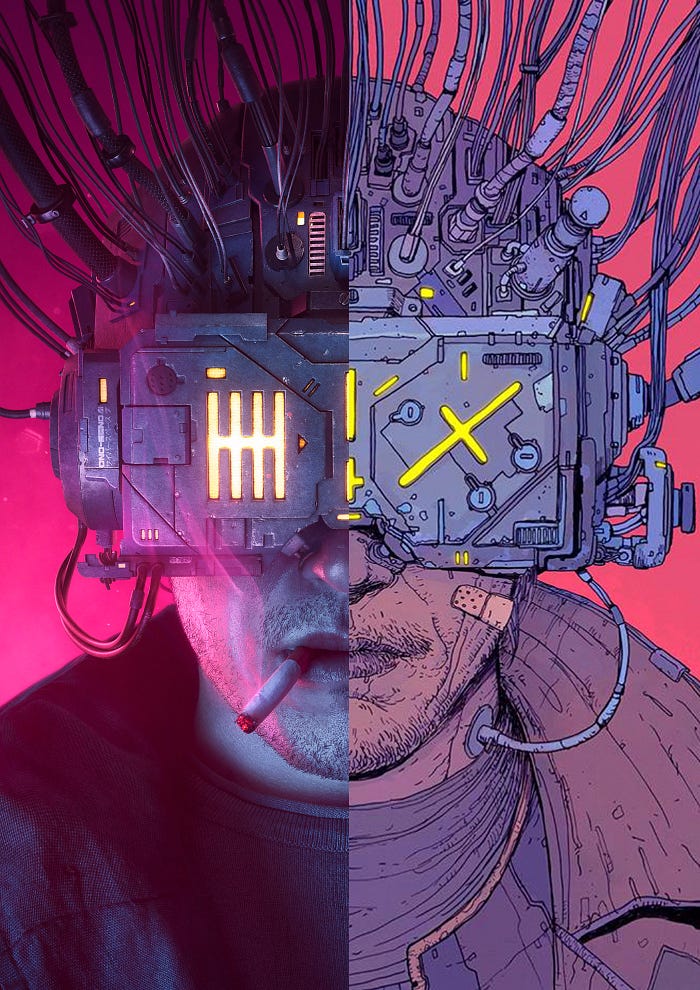
In this page the images comes from:

      1. Gerd Altmann from Pixabay
      2. Pete Linforth from Pixabay

In this post the dialogue is realised by an interaction of virtual characters, for more information please check the page “Virtual characters

John

Hi Cho, can I ask you some questions about brain implants?

Today 15:43

Cho

Hi John, sure, ask away 😉                                                                       

Today 15:43

John

I’m collaborating with a journalist, Manuel, on a piece about the connections between science and Sci-Fi

Today 15:43

Cho

Interesting, there’s a lot of hype an misinformation out there, this sounds useful. 🙂

Today 15:44

John

Indeed! Specifically, I’d like to go over one example of an implant from a book

Today 15:44   

Cho

OK, I’ve read a lot of sci-fi as a student, I hope I know it … 😄           

Today 15:45

John

It’s called “The Turing Option” by Harry Harrison and Marvin Minsky

Today 15:45   

Cho

I know Minsky of course!, he founded MIT’s AI laboratory!                 

Today 15:46

John

Good! So they co-wrote this book about a brain implant that can help heal brain damage

Today 15:46   

Cho

Cool, I don’t know the book, but I wish we had such a thing. How would this device work?

Today 15:47

John

Basically they implant a tiny supercomputer in the damaged area, which would reconnect severed neurons

Today 15:48   

Cho

That does sound like sci-fi indeed: the question is how?. 😏             

Today 15:48

John

They use something called “PNEP film chips—programmable neural electron pathway devices

Today 15:49   

John

these are “coated with living embryonic human nerve cells”, first attached to an external computer, later to the implant

Today 15:49  

Cho

This actually starts to sound realistic, Minsky knew what he was doing.

Today 15:50

John

So this checks out? We can do something like this nowadays?

Today 15:51   

Cho

Yes and no. Forget about the scale of the problem, we can’t deal with millions of neurons yet

Today 15:52

Cho

and even a supercomputer can’t keep up with the brain, let alone an implantable one!

Today 15:53

John

OK the problems of scale, but in principle? Repairing the brain?

Today 15:53   

Cho

Maybe. We can inject stem-cells and these would indeed reform connections in a damaged area,

Today 15:54

Cho

and we can implant a chip in the brain to receive and send impulses, “read and write” if you like.

Today 15:55

Cho

The trick would be to link those: guiding regrowth with AI.                
In principle, that should be possible.                         

Today 15:56

John

Great! Thank you so much!

Today 15:57   

… Continue reading our conversations that are posted every Saturday
Next week John will talk with

Sam our Computer Scientist and AI Expert

1 Star2 Stars3 Stars4 Stars5 Stars (4 votes, average: 4.25 out of 5)
Loading...

Related post

Life Imitating Science

Life Imitating Science

Life Imitating Science

Our children should be studying Arthur C. Clarke, William Tenn, Robert Heinlein, Ray Bradbury and Robert Sheckley, not because these writers can tell them about rocket ships and time machines but, more important, because they can lead young minds through an imaginative exploration of the jungle of political, social, psychological, and ethical issues that will confront these children as adults

Alvin Toffler

Manuel and John are talking about the following article:
The Prophets of Science Fiction Explores Sci-Fi’s Best Writers

In this post the images comes from:

      1. Amina Filkins from Pexels
      2. Miriam Espacio from Pexels
      3. Pete Linforth from Pixabay

In this post the dialogue is realised by an interaction of virtual characters, for more information please check the page “Virtual characters

Manuel

Hi John, would you like to collaborate on some articles with me?

Today 11:41   

John

Hi Manuel, happy to! What is it about?                                                   

Today 11:42   

Manuel

Well, my editor saw this series from ten years ago: “Prophets of Science Fiction

Today 11:43   

Manuel

and now he wants to do a series of articles discussing science and sci-fi

Today 11:43   

John

Oooh, sounds interesting!                                                                        

Today 11:44   

Manuel

Yeah, seems that it made some controversial claims at the time

Today 11:45   

John

Like what?                                                                                                    

Today 11:45   

Manuel

Mostly that they exaggerated a lot, like Frankenstein anticipates superhuman cyborgs

Today 11:46  

John

Ouch, that is quite a stretch …                                                                 

Today 11:46   

Manuel

Actually, that’s why I am asking you to help out … to help keep hype out and realism in

Today 11:48   

John

Okay, I might be able to help, or otherwise know who to ask for help.

Today 11:48   

Manuel

Great! Much appreciated!

Today 11:49   

John

So are you going to use the same setup as the series? Should I watch it first?

Today 11:50   

Manuel

Actually, yes and no. We’re not going to use exactly the same list authors …

Today 11:51   

John

… but there likely will be some overlap                                                  

Today 11:51   

Manuel

Indeed, and science has moved on, we expect.

Today 11:52   

John

Ha! So what would you need from me, exactly?                                   

Today 11:52   

Manuel

I’ll send you some drafts, could you check them over with an expert on brains and brain implants?

Today 11:53   

John

Sure, I know just who to ask!                                                                    

Today 11:53   

Manuel

I’ll head over to a contact to talk about robots. See you later!

Today 11:54   

… Continue reading our conversations that are posted every Saturday …
Next week John will talk with Cho our Neuroscientist

1 Star2 Stars3 Stars4 Stars5 Stars (4 votes, average: 4.25 out of 5)
Loading...

Related post

Total posts on the argument

No Results Found

The page you requested could not be found. Try refining your search, or use the navigation above to locate the post.

As the World Seems

As the World Seems

As the World Seems

We have heretofore confused the notion of the power with which the soul acts on the body with the power with which one body acts on another.

Descartes to Elizabeth, 21 May 1643

Julia and John are talking about the following article:
Brain wifi

In this post the images comes from:

  1. Pete Linforth from Pixabay
  2. Wilson Vitorino from Pexels

In this post the dialogue is realised by an interaction of virtual characters, for more information please check the page “Virtual characters

John

I must say, I really liked the conclusion of your piece 😉

Today 17:07   

Julia

Thanks! 😊                                                                                                  

Today 17:07

John

I had no clue that Brentano was an inspiration for both Gestalt psychology and phenomenology

Today 17:08   

Julia

Once you go looking for stuff like intentionality you can’t get around Brentano really

Today 17:08

John

Yeah, intentionality always seemed like a topic that was too technical

Today 17:09   

Julia

Do you think I explain it OK?  😊                                                             

Today 17:09

John

As far as I can see, yes, but I’m no philosopher. The way you link it consciousness works really well though

Today 17:10   

Julia

We seem to leave the thinking subject out of the equation when we just look at the brain

Today 17:11

John

Yeah, we can see the stimulus, the thing in the world that causes our impressions

Today 17:11  

Julia

and we can see the chain of effects it has on the brain                      

Today 17:12

John

but it seems like we don’t really look at the one doing the thinking, having the thoughts anymore.😏

Today 17:13   

Julia

Brentano helps a lot there, since he makes it clear it is precisely not the soul or spirit or whatever that is the problem

Today 17:14

John

Right, the whole “psychology without a soul” thing you quote

Today 17:14   

Julia

Yep: Lange’s History of Materialism from 1866.                                   

Today 17:15

John

Ha! You certainly know your stuff.😊

Today 17:15   

Julia

The main point is that phenomenology reminds us that it is not just objects affecting objects, the world affecting the brain

Today 17:16

Julia

but objects affecting subjects, the world appearing to a conscious mind.

Today 17:16

John

I still think that the last bit might be a bit abstract for a lot of readers, but as I said: I liked it! 😊

Today 17:17   

Julia

So you think the magazine will accept it?                                               

Today 17:18

John

I think so, but there will no doubt be some requests for changes and copyediting to deal with

Today 17:18   

Julia

Great! I look forward to how people will react to it! 😊                     

Today 17:20

… The End …

1 Star2 Stars3 Stars4 Stars5 Stars (4 votes, average: 4.25 out of 5)
Loading...

Related post

Write What you don’t Know

Write What you don’t Know

Write What you don’t Know

The task of a science of consciousness is to systematically integrate two key classes of data into a scientific framework:

Third-person data, or data about behavior and brain processes
and
First-person data, or data about subjective experience

Chalmers 2004

Julia and John are talking about the following article:
Do We Need To Study The Brain To Understand The Mind?

In this post the images comes from:

  1. Suzy Hazelwood from Pexels
  2. Markus Spiske from Pexels

In this post the dialogue is realised by an interaction of virtual characters, for more information please check the page “Virtual characters

Julia

I think I’ve got the final part worked out now                                        

Today 17:06

John

I agree, this makes for a nice closer to the series😊

Today 17:07   

Julia

Since you mentioned Descartes _twice_ I just had to include him😊 

Today 17:07

John

Ha! But I couldn’t believe what you wrote at first and had to look it up 😄

Today 17:08   

Julia

That Descartes is not actually a dualist? I was surprised too at first

Today 17:08

John

Yeah! I always thought he was the main example for completely separating mind and body

Today 17:09   

Julia

Well, in a sense you’re right, but he also does say that “I and the body constitute one single thing”

Today 17:09

John

Sounds perfectly logical, but the way he explains the link …

Today 17:10   

Julia

He just points out that mind-body interaction works differently from body-body interaction

Today 17:11

John

So looking at how matter and energy bounce around in the brain …

Today 17:11  

Julia

… can’t tell the whole story about the mind and consciousness        

Today 17:12

John

I think I actually agree, but isn’t that very sceptical? 😏

Today 17:13   

Julia

A bit: “Ignoramus et ignorabimus” (Du Bois-Reymond 1872)             

Today 17:14

John

My French might be rusty, but my Latin is non-existent

Today 17:14   

Julia

“We don’t know and will never know” how the brain causes the mind

Today 17:15

John

And that gives you the jumping-off point to discuss alternatives

Today 17:15   

Julia

Indeed! Do you think it works?                                                                 

Today 17:16

John

As long as you keep the Latin to a minimum … 😊

Today 17:17   

Julia

I’ll just paraphrase him then and reference the original                     

Today 17:18

John

That would be better. 👍

Today 17:18   

… Continue to read the conversation between John and Julia 
on Saturday 24th July…

1 Star2 Stars3 Stars4 Stars5 Stars (4 votes, average: 4.25 out of 5)
Loading...

Related post

The ends justify the rules

The ends justify the rules

Complicated mental processes are entirely reducible to such simple activities as the attentive observation of statements previously accepted as true, the perception of structural, purely external, connections among these statements, and the execution of mechanical transformations as prescribed by the rules of inference

read more

Barking up the Evolutionary Tree

Barking up the Evolutionary Tree

Barking up the Evolutionary Tree

Throughout nature almost every part of each living being has probably served, in a slightly modified condition, for diverse purposes, and has acted in the living machinery of many ancient and distinct specific forms.

Darwin 1862, 348

Julia and John are talking about the following article:
A New Theory Explains How Consciousness Evolved

In this post the images comes from:

  1. Misha Voguel from Pexels
  2.  Chris Helgren / Reuters
  3. liggraphy from Pixabay

In this post the dialogue is realised by an interaction of virtual characters, for more information please check the page “Virtual characters

John

OK, I got your draft, read it through, and I have some suggestions

Today 17:05

John

First of all: it is too long and too detailed, I suggest we split it up 😉

Today 17:06

Julia

So I can elaborate and explain?                                                              

Today 17:06

John

Indeed. But I did like the setup of the argument a lot! 😊

Today 17:07   

Julia

Nice! I noticed there were so many early breakthroughs thanks to experiments on the brain 🧠

Today 17:07

John

that this became the dominant paradigm and we kinda forgot about consciousness

Today 17:08   

Julia

Exactly! And then there is the bit at the end about the alternatives

Today 17:08

John

OK, you should work those out in a separate article, and you have to explain about Darwin first

Today 17:09   

Julia

“The difference in mind between man and the higher animals, great as it is, certainly is one of degree and not of kind”                    (Darwin 1871, 106)

Today 17:09

Julia

This basically allowed us to translate what happens in animal brains to human brains

Today 17:10

Julia

and since for the longest time animals were seen as barely more than machines …

Today 17:11

John

… basically we’re back to Descartes, who thought our bodies were biological robots. 🤖

Today 17:12   

Julia

It basically enabled the whole paradigm: to understand the mind, we investigate the brain, humans are sufficiently like animals, so …

Today 17:14

John

we can learn about humans by studying animals, and reduce the whole shebang to biological mechanisms. Clever.

Today 17:15  

Julia

And then I introduce some alternative approaches and critiques    

Today 17:15

Julia

William James said that despite all the biological explanations it is still a complete mystery “how a motion became a feeling”.

Today 17:16

John

You do need to explain that a bit more though …

Today 17:17   

Julia

Basically by reducing the mind to the brain we try to explain consciousness by matter in motion …

Today 17:18

John

… basically we’re back to Descartes. Sorry, I’m repeating myself 😄

Today 17:18   

Julia

Well, Descartes thought that this couldn’t be done at all, that we needed something other than matter to explain the mind

Today 17:20

… Continue to read the conversation between John and Julia 
on Saturday 17th July…

1 Star2 Stars3 Stars4 Stars5 Stars (4 votes, average: 4.25 out of 5)
Loading...

Related post

Fire All Neurons!

Fire All Neurons!

Mechanical analog computers had their origins in Naval Gunnery in World War I […] mechanical analog computers remained of considerable military importance certainly until well into the 1960s and have only been superseded by digital computing systems in the 1970s.

read more